
How to Choose the Right Single Wall Corrugated Pipe Winder (Coiler): Speed vs. Efficiency
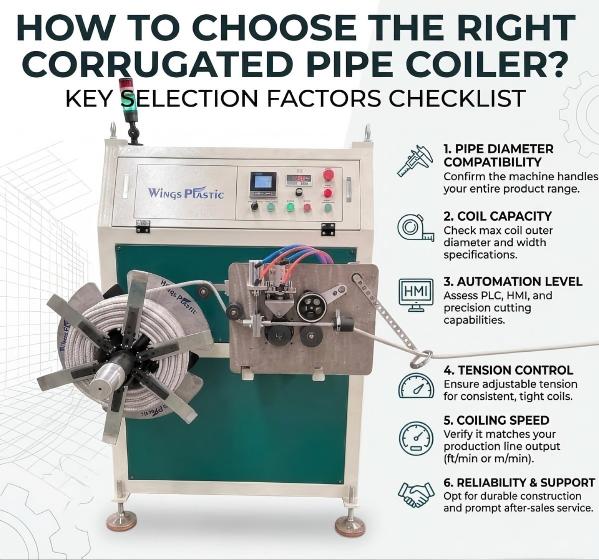
After several generations of technical innovations in extruders and corrugators, the production speed of Single Wall Corrugated (SWC) pipes has increased dramatically. However, winding technology has often struggled to keep pace, making the coiler the ultimate bottleneck in the factory.
Choosing the right winder is no longer just about buying an accessory; it is a critical decision that directly dictates your actual production efficiency. Currently, Wings Plastic offers a comprehensive range of winding solutions:
- Manual Winders
- Standard Single/Double-Station Winders
- Servo-Traversing Double-Station Winders
- Auto-Cutting Single/Double-Station Winders
- Fully Automatic Cutting & Packaging Winders
How do you choose? Here is our practical, engineer-backed guide.
1. The High-Speed Dilemma: The 30 m/min Paradox
Because SWC pipes are typically coiled in lengths of 25 to 100 meters, high-speed extrusion creates an intensely short winding cycle.
Consider a small 16mm pipe running at a maximum speed of 30 m/min with a roll length of 100 meters. The coiler will finish a roll every 3.3 minutes. If you are using a standard inline winder, the operator has less than 1 minute to manually cut, tie the roll, unload it, and reset the spool.
If the operator fails to keep up, the pipe will accumulate on the factory floor. This floor pile-up causes the pipe to bend and twist, which subsequently ruins the automatic traversing mechanism (the pipe will not align tightly on the next spool). This creates a high-stress, exhausting environment for workers.
The Paradoxical Reality: When running at 30 m/min, many experienced operators actually prefer Manual Winders. With a manual setup, the operator can wind faster and manually adjust the traversing, completely ignoring the deformation caused by pipes piling up on the floor.
2. The “Sweet Spot”: Why We Designed the 10-15 m/min Corrugator
Because of the winding bottleneck mentioned above, many clients who purchase 30 m/min high-speed lines end up forcing their operators to artificially reduce the machine speed to 15 m/min just to keep the inline winder functioning smoothly without causing operator burnout.
This means clients are paying a premium for a 30 m/min machine but only realizing 50% of its value.
This operational reality is exactly why Wings Plastic explicitly designed the 10-15 m/min SWC Corrugator. This specific speed is the “Golden Ratio” for matching with standard auto-traversing and auto-cutting winders. It prevents bloated initial equipment costs while ensuring that the theoretical production speed matches the actual, sustainable factory floor output.
3. The Truth About Fully Automatic Winders
Many investors assume that a “Fully Automatic Cutting & Packaging Winder” will instantly save labor costs. We do not recommend this for regions with affordable labor.
A fully automatic winder often costs upwards of $20,000 USD. More importantly, it requires highly skilled technical personnel for daily operation and maintenance. For a factory with only 1 or 2 lines, an automatic winder will not reduce your costs; the maintenance overhead will actually increase them.
When does it make sense? Fully automatic winders are strictly designed for large-scale operations with 4 or more production lines, where a single high-level engineer can oversee the automated winding of all lines simultaneously. For the general market, the entry barrier and ROI simply do not align.
4. The Wings Plastic Top Recommendation
After evaluating hundreds of factory setups globally, we have identified the absolute best configuration for cost-performance (ROI) and operational ease:
The Golden Combo: A 10-15 m/min Corrugator paired with an Auto-Cutting Single-Station Winder.
- Why? The speed perfectly matches human working rhythms. The auto-cutting feature eliminates the most time-sensitive manual task. It offers an exceptionally high ROI, and most importantly, one single operator can easily manage two production lines simultaneously without fatigue. For the vast majority of our clients, this configuration maximizes profitability and minimizes headaches.
Explore our full range of corrugated pipe coilers and winders designed to match your exact line speed — from manual to fully automatic systems.