
Flame-Retardant Single-Wall Corrugated Pipe: PVC and PE/PP
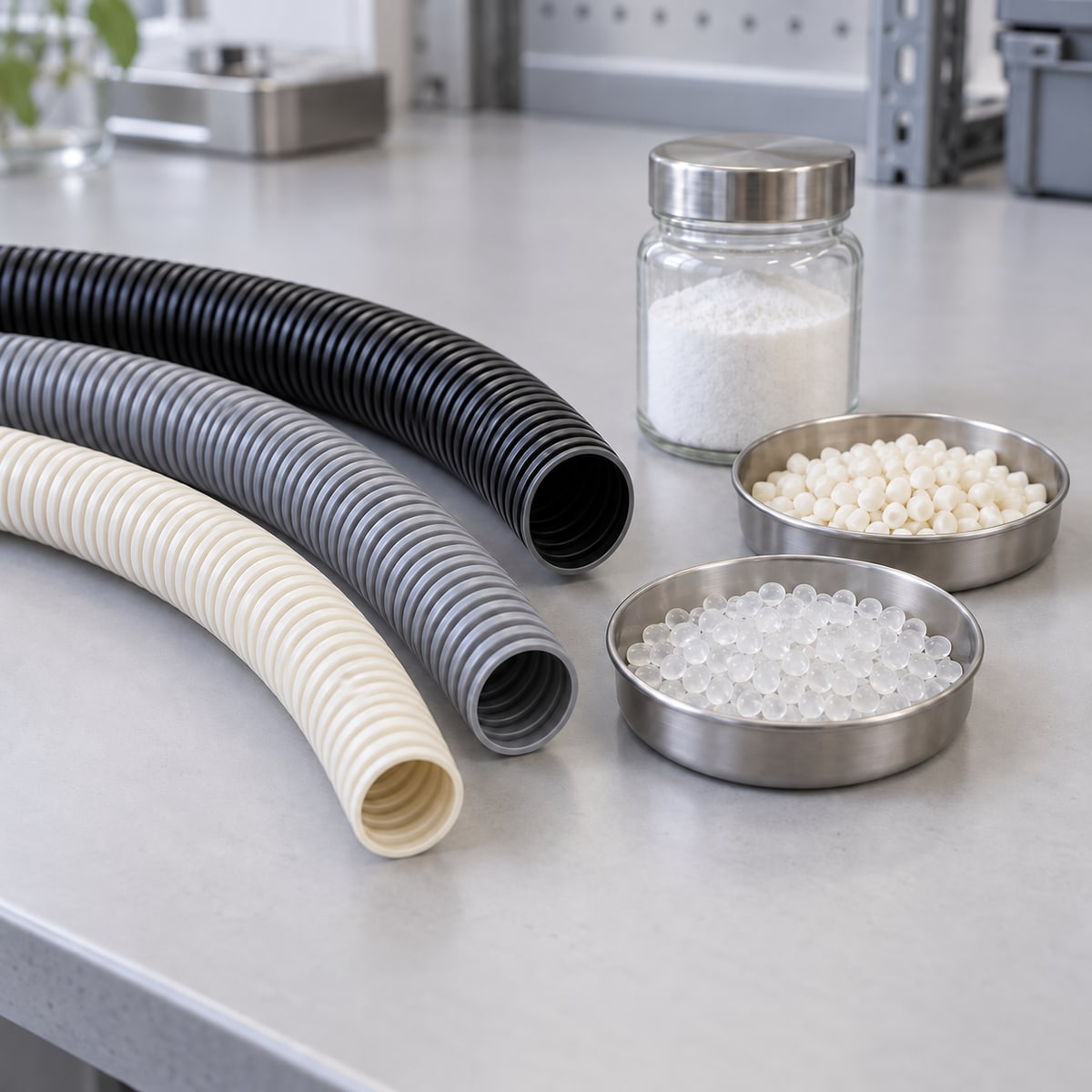
Single-wall corrugated pipe used for cable protection, building conduit and equipment wiring may need to limit flame propagation as well as provide flexibility and compression resistance. There are two common material routes: choose a PVC compound with inherent flame-retardant advantages, or use flame-retardant-modified PE or PP.
The difference is where the flame-retardant performance comes from. PVC’s molecular structure contributes to its fire behaviour; ordinary PE and PP generally need a specifically designed flame-retardant system. A pipe corrugator shapes the melt into pipe. It cannot simply turn an ordinary material without a flame-retardant formulation into a flame-retardant material.
1. Route one: use PVC’s inherent flame-retardant advantages
PVC is polyvinyl chloride, with chlorine in its molecular chain. Compared with ordinary PE and PP, this structure gives PVC lower flammability and advantages in limiting flame propagation. Selecting a suitable PVC compound is therefore a direct route to flame-retardant single-wall corrugated pipe. ECVM’s explanation of PVC physical properties also relates this advantage to chlorine.
Here, “using PVC directly” means selecting a formulated PVC pipe compound suitable for the application, not feeding pure PVC resin powder into any extruder. PVC processing normally still requires heat stabilisers and lubricants, with plasticisers, impact modifiers, pigments and other ingredients selected as needed. The PVC additives overview explains their different functions.
Three distinctions matter in purchasing and production:
- PVC’s flame-retardant advantages do not mean every PVC pipe automatically complies. Plasticiser type and loading, other additives, reprocessed material and actual wall thickness can change finished-product performance. Flexible PVC particularly requires checking the complete formulation.
- Flame-retardant does not mean non-combustible. Under sustained flame or sufficient heat, PVC may still burn or decompose, producing smoke and acidic gases such as hydrogen chloride (HCl). ECVM’s material information also discusses combustion smoke.
- PVC is not halogen-free. Where a customer also requires halogen-free materials, PVC’s flame-retardant advantages cannot substitute for a halogen-free solution.
A pipe manufacturer can first specify diameter, wall thickness, flexibility, service temperature and target tests to the supplier, obtain the corresponding PVC compound and test data, and then verify performance on the corrugated pipe actually produced.
2. Route two: why do ordinary PE and PP need flame-retardant modification?
PE is polyethylene and PP is polypropylene; both are polyolefins. Their flexibility, stiffness and temperature performance differ, but ordinary non-flame-retardant grades are generally combustible. Choosing black material, adding a conventional colour masterbatch or changing the corrugation shape does not replace flame-retardant formulation design.
Specialised flame retardants or a coordinated system can improve fire behaviour while retaining the desired characteristics of PE or PP, provided they are dispersed uniformly in the resin. Selection must consider the specific PE or PP grade: a formulation developed for PE cannot be assumed to work identically in PP.
“Flame-retardant pellets” can refer to very different products. Clarify which is being supplied:
- Complete flame-retardant compound: the resin, flame-retardant system and other necessary additives have already been melt-compounded. A grade explicitly suitable for pipe extrusion can be processed according to the supplier’s instructions. Do not dilute it with ordinary resin to reduce cost while continuing to rely on the original flame-retardancy report.
- Flame-retardant masterbatch: a higher concentration of flame-retardant ingredients pre-dispersed in a carrier resin, added at a specified ratio to compatible PE or PP. Coperion’s masterbatch process description likewise defines a masterbatch as an additive concentrate in a polymer carrier. Masterbatch loading is not the same as the active flame-retardant content in the final material.
- Flame-retardant powders or additive blends: ingredients for formulation development that require accurate dosing, melt compounding and quality control. They are not powders that necessarily work simply by being poured into the hopper.
For manufacturers without formulation-development and compounding facilities, evaluating a complete flame-retardant compound suitable for thin-wall corrugated-pipe extrusion usually makes it easier to relate material batches, processing parameters and finished-product tests.
3. What are flame retardants, and how do they work?
Flame retardants are additives used to reduce flammability or delay the development of combustion. Different systems can absorb heat, promote protective layers or reduce the participation of combustible decomposition products. Some also inhibit gas-phase combustion chain reactions.
Flame retardants do not necessarily dissolve in PE or PP. Many mineral or blended additives remain as a dispersed phase, so agglomeration, resin compatibility and consistent final loading all influence performance.
Aluminium hydroxide and magnesium hydroxide: heat absorption and protective residue
Aluminium hydroxide is commonly abbreviated ATH, and magnesium hydroxide MDH. On thermal decomposition, they absorb heat, release water and leave an inorganic residue, contributing to reduced heat feedback and a barrier to combustion. They can be used in halogen-free systems, but whether the complete formulation is halogen-free or low-smoke must still be verified separately.
They cannot be interchanged solely on price. ATH generally has a lower thermal-stability window than MDH. For formulations processed at higher temperatures, check whether the additive could decompose prematurely during compounding or extrusion. Huber’s material information explains this distinction. Use technical data for the actual grade; a decomposition temperature is not a barrel-temperature setting.
Mineral flame-retardant systems often require high filler loadings, which can affect melt flow, elongation, bending performance and pipe weight. For single-wall corrugated pipe that must bend repeatedly, evaluate flame retardancy and flexibility together rather than simply increasing powder content.
Phosphorus–nitrogen intumescent systems: an insulating char layer
These systems often use ingredients such as ammonium polyphosphate (APP). Through coordinated phosphorus, nitrogen and char-forming components, they form an expanded protective layer when heated, limiting heat transfer and the exchange of combustible decomposition products. This is generally a coordinated system: adding APP alone is not equivalent to a complete flame-retardant formulation.
For example, Clariant’s Exolit AP 766 technical information describes a phosphorus–nitrogen intumescent system for polyolefins, with requirements for uniform dispersion and controlled thermal history. Resin grade, processing method and material thickness must therefore be considered together. A supplier’s results on specific specimens are not direct proof that a thin-wall corrugated pipe complies.
4. How are flame retardants incorporated into PE and PP?
The aim is a stable, uniform formulation throughout the pipe wall. A common sequence is: select resin and flame-retardant system → dose accurately → melt-compound → vent and pelletise → trial pipe production → test the finished pipe.
Step one: define finished-product requirements
Before discussing additive loading, define the application, target market, diameter, minimum wall thickness, whether the conduit is split, minimum service temperature and bending requirements, as well as any halogen-free, low-smoke or electrical requirements. Supply these conditions to the material supplier so that resin and additive selection has an application-specific basis.
Step two: weigh and prepare the complete formulation
Dose PE or PP, flame retardants, carrier, pigments and other additives against the same formulation. Continuous production can use metering feeders appropriate for each material. Powders and pellets differ in bulk density and flow behaviour, so watch for bridging, segregation and feed-rate fluctuations.
Check moisture condition and drying requirements against the technical data. Low moisture absorption by the base PE or PP does not mean an additive-containing compound needs no moisture control. Handle powders with enclosed transfer, dust extraction and personnel protection as specified in the safety data sheet.
Step three: mix effectively in the melt
A twin-screw extruder with suitable mixing and feeding configurations is commonly used to melt the base polymer, disperse the flame-retardant ingredients and remove moisture and volatiles where needed. Coperion’s compounding process description illustrates main feeding, side feeding, dispersion and venting.
Uniform dry blending is not the same as uniform melt dispersion. Powders stirred with pellets in a hopper may still agglomerate or segregate during transport. A conventional single-screw pipe extruder primarily plasticises the material and provides a stable melt supply; do not assume without validation that it can adequately compound a highly filled powder formulation. An in-line compounding system demonstrated suitable by the supplier and equipment trials should follow its validated process.
Compounding must balance dispersion against thermal damage. Screw configuration, actual melt temperature, residence time and shear heating must suit the flame-retardant system. Increasing speed or temperature alone is not a reliable way to disperse powders.
Step four: pelletise and check consistency
Cool and cut the compounded material using a method suitable for the formulation, and control residual moisture. Check pellet appearance, batch consistency, processing flow behaviour and relevant properties before trial single-wall corrugated-pipe production.
Step five: validate actual pipe, not just pellets
Produce samples using the intended production moulds, wall thickness, line speed, colour and reprocessed-material ratio. Inspect wall distribution at crests, valleys and around the circumference, then test flame retardancy, bending, impact and compression performance as required. Only then can the formulation be tied to a deliverable finished product.
5. How should flame-retardant masterbatch loading be interpreted?
Confirm that the carrier suits the selected PE or PP, the supplier’s specified addition rate, and the base resin and specimen thickness covered by the report. Do not transfer one masterbatch’s ratio to another brand or resin.
For a simplified mass balance, assuming the base resin contains none of the same flame-retardant ingredient and there are no other sources:
Final active flame-retardant mass fraction = masterbatch mass fraction in the total formulation × active ingredient mass fraction in the masterbatch.
For calculation only, consider a 100 kg batch containing 20 kg masterbatch and 80 kg base resin. If the supplier specifies that the ingredient being counted forms 50% of the masterbatch, the final batch contains 10 kg of that ingredient, or 10% by mass.
This is not a recommended formulation, and it does not mean 10% achieves any particular flame rating. It simply shows that 20% masterbatch loading is not 20% active flame retardant. Actual dosing, synergistic components and permitted colour masterbatch or reprocessed-material additions must follow the supplier’s validated complete formulation.
Even a masterbatch approved for direct addition requires stable metering and sufficient melt mixing. If pipe-wall dispersion or flame-test results vary, inspect feeding and mixing conditions and, where necessary, pre-compound and pelletise. Do not merely keep increasing masterbatch loading.
6. What needs particular control during single-wall corrugated-pipe extrusion?
Select an extrusion-suitable grade
A flame-retardant injection-moulding compound is not necessarily suitable for continuous thin-wall pipe extrusion. Confirm that melt strength, flow, elongation and mould-forming behaviour meet the target diameter, corrugation depth and production speed.
Control actual melt temperature and residence time
Start with the complete-compound supplier’s processing window and adjust using extruder load, pressure and actual melt condition. Local overheating or excessive residence time can damage the resin, stabilisers or flame-retardant ingredients. Bubbles, unusual odour, discoloration or black specks require investigation of moisture, degradation and contamination.
Watch thin sections and dispersion defects
Wall thickness is not uniform everywhere in a single-wall corrugated pipe. Valleys, transitions and more heavily stretched areas may become weak points, while agglomerates can create local defects. Coordinate extrusion output, forming speed, vacuum or air pressure and mould cooling; do not judge wall quality solely by average mass per metre.
Keep formulations and batches traceable
Unvalidated additions of ordinary PE/PP, other colour masterbatches or reprocessed material can dilute or interfere with the flame-retardant system. When changing resin, additive, colour, wall thickness or key process conditions, assess whether revalidation is required instead of simply relying on an old report.
7. How do you establish that the finished product meets the requirements?
Choose tests around the intended application, not merely whether the raw material is “V-0”. Distinguish the following:
- UL 94: classifies burning behaviour of small plastic specimens under specified conditions; results depend on material, thickness and other conditions. It does not automatically replace applicable finished-conduit tests or establish a fire-resistance duration. See UL’s explanation of rating scope and limitations.
- Oxygen index (LOI/OI): methods such as ISO 4589-2 determine the oxygen volume fraction needed to sustain combustion of small specimens under specified conditions. It can support material comparisons, but cannot be directly converted into a UL 94 rating or conduit-compliance conclusion.
- Finished-conduit requirements: depending on the market, cable-management conduits may be assessed using IEC 61386-1 and the applicable particular part. IEC 61386-23 is an example for flexible conduit systems. Select the part according to product classification; a corrugated appearance alone does not determine the category.
Reports should correspond to the actual pipe model, material, colour, wall thickness and specimen condition. Flame retardancy, halogen-free composition, low smoke and fire resistance are different requirements and need separate confirmation. A workshop lighter observation can show preliminary behaviour, but cannot replace testing with prescribed specimens, ignition sources, conditioning and acceptance criteria.
8. Material-selection guidance for single-wall corrugated-pipe manufacturers
Where halogen-containing materials are permitted, start by evaluating a suitable PVC compound, use its inherent flame-retardant advantages and verify finished-pipe performance. If the project requires particular PE or PP properties or a halogen-free material, select a complete formulation designed and tested accordingly.
For a first flame-retardant single-wall corrugated-pipe project, define finished-product requirements, obtain extrusion suitability data, processing windows and test conditions from the supplier, and run small production trials. Evaluate developing powder or masterbatch formulations in-house once stable compounding, dosing and testing capabilities are available.
When selecting a Single Wall Corrugated Pipe Machine or PVC/PE electrical conduit machine, provide Wings Plastic with the proposed material data, target diameter and wall thickness, performance requirements and output. This supports assessment of extrusion, mould-forming and cooling configurations. Flame-retardant performance comes from the formulation and stable processing together, and must ultimately be confirmed on actual pipe.
The image illustrates single-wall corrugated pipe, polymer pellets and additives; it does not represent a specific grade’s formulation or fire-test results. Supplier information explains technical principles and is not certification or a recommendation of a particular grade for this project.