
Single-Wall Corrugator Selection: Market Reach Before Speed
Summary: work out the business before choosing the machine
When buying corrugated pipe equipment, the first question should not be “How many metres per minute can it run?” It should be “Who will buy my pipe, how far can I sell it, and how much can I sell each month?”
Most corrugated pipe has a low goods value, is lightweight, and takes up a lot of transport space. The farther it travels, the more freight can eat into profit. In a large country or a large regional market, sufficient orders make high speed useful. In a small country serving mainly local customers, that much output may not be needed.
A small market may not need high speed, but it does need a stable machine that is easy to operate and lasts. Choosing 44 or 72 pairs of mould blocks and a suitable coiler should start with that practical need.
1. Freight determines how far your pipe can be sold
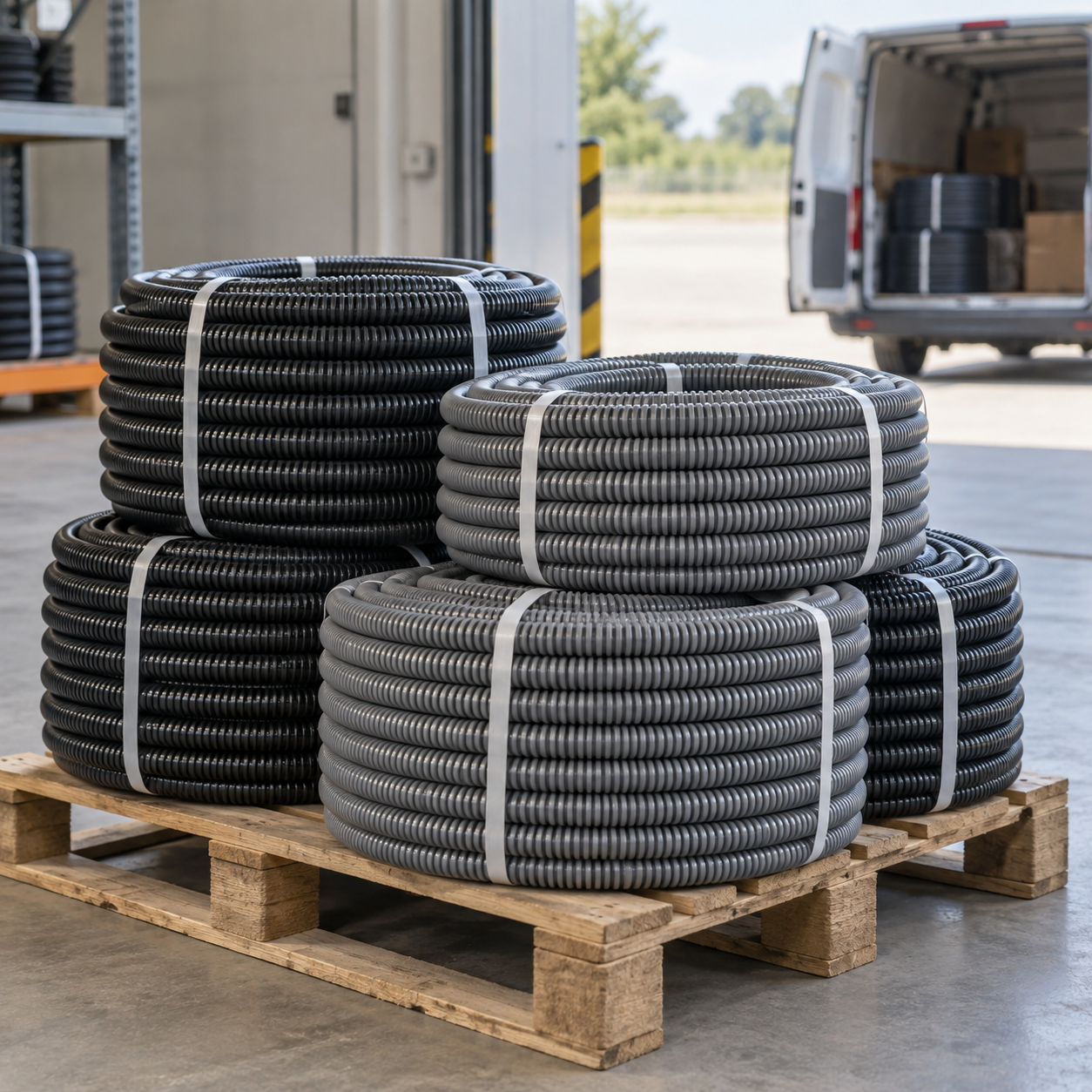
Corrugated pipe has three obvious characteristics: low goods value, low weight and a large volume. A truck is often full before reaching its weight limit. The pipe itself does not sell for a high amount, but long-distance freight still has to be paid.
Goods value means the monetary value of the goods, not the profit margin. A profitable type of pipe does not necessarily make a truckload of it high-value cargo. Freight therefore remains an unavoidable issue in this business.
For nearby customers, freight may be affordable. Farther away, adding freight can make buying locally more attractive. The distance over which you can still sell competitively is your sales radius. Work out how far your pipe can sell before deciding how fast your machine needs to be.
- First, check your sales reach: mainly local customers, or deliveries across regions?
- Next, check steady sales: how many metres can you sell each month, not just the occasional peak-season order?
- Finally, calculate delivered cost: after materials, labour, packaging and freight, how much profit remains?
Higher speed does not automatically mean more profit. Speed is worth investing in when your market can use the output.
2. Two markets, two approaches to selection
1. Large countries and regional markets: with enough orders, speed has value
In a large market such as China, there are many customers and convenient transport between provinces, giving a factory opportunities to sell farther away. When orders can absorb the output, making more pipe each day spreads the same labour and factory costs over more metres and helps lower the cost per metre.
These factories need speed, but extrusion, cooling and coiling must all keep up. A fast corrugator alone is not enough.
2. Small countries and local markets: stability and ease of use matter more than top speed
In some small countries or areas with a limited sales reach, customers are mostly nearby. Pipe cannot be sold very far away, and the market cannot absorb large daily volumes. If a normal configuration finishes the orders in a few hours, a faster machine often just stops earlier.
These small factories need three things most: less scrap, easy operation and straightforward maintenance. Where spare parts are difficult to obtain, waiting many days during a breakdown is more troublesome than running a few metres per minute slower.
The size of the country and sales region gives a simple first guide; then look at the orders you actually have. A factory in a small country with steady export orders can still consider high speed. A factory in a large country serving only nearby customers need not chase excessive output.
| Comparison | Large market, many orders | Small market, mainly local sales |
|---|---|---|
| First priority | Sustained output and lower unit cost | Reliable deliveries and controlled investment and maintenance costs |
| Configuration focus | Enough cooling, with extrusion and coiling keeping up | Reliable structure, easy operation and sensible capacity |
| Do not overlook | Consistent quality during long high-speed runs | Low speed is no reason to accept structural weaknesses |
3. The key to high speed: mould blocks need time both to absorb and release heat
Freshly extruded plastic is hot. As the mould blocks close around it, they form the corrugations and remove heat. The pipe cools, but the blocks absorb that heat. The blocks must release it before they can keep cooling the next section of pipe.
Cooling must therefore be considered not only along the section where blocks touch the pipe, but also while they move aside and return to the inlet.
1. Start with the structure: rails support and locate the blocks; the cavity ribs form the pipe
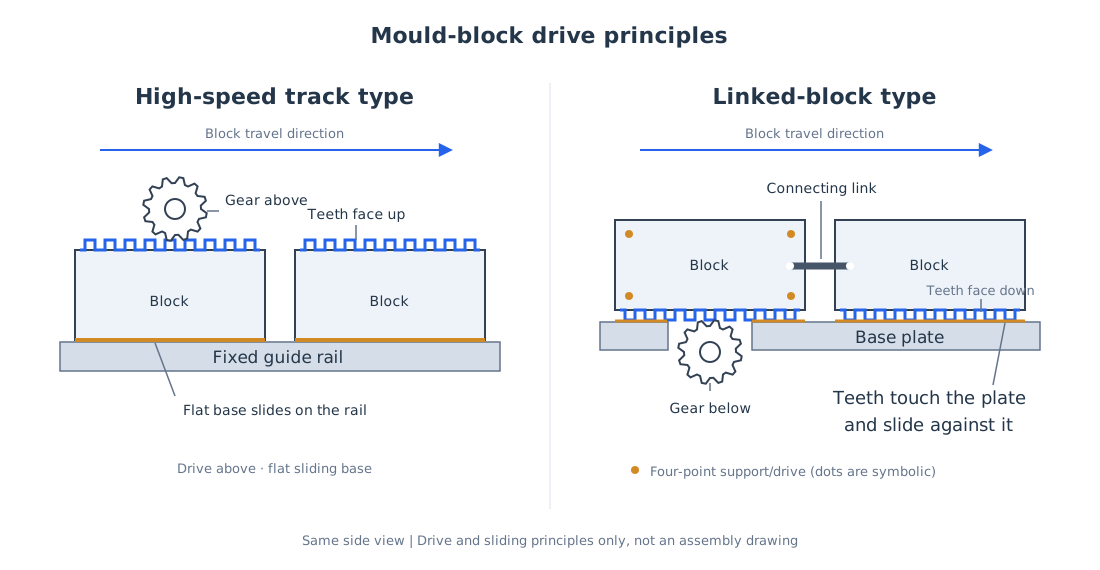
In the gear-and-track arrangement discussed here, gears drive the blocks along guide rails, without hinges linking adjacent blocks together. The rails keep movement steady and the closing blocks aligned. The corrugated cavity inside the blocks directly contacts the melt and forms the pipe.
Two kinds of “teeth” must be distinguished: the forming ribs inside the cavity shape the corrugations, while the teeth of the drive rack transmit motion. Cooling of the exposed forming surfaces after opening refers to the former.
Mould-block drive principles compared
2. After opening, the mould blocks are still cooling
Once the pipe has set and can retain its shape outside the mould, the blocks can separate and move to the side for their return. Although they no longer touch the pipe, they are still cooling. The return journey gives them more time to shed heat.
The forming surfaces previously touching the pipe become exposed and can release heat to the surrounding air. Where the return section has water-cooled rails, heat can also continue passing from the blocks through the rails. Cooling is not limited to contact with the pipe: blocks can release heat throughout their circuit.
The same hot plastic transfers heat more readily on first contact with a sufficiently cooled block than with one that is still hot. A suitable return temperature helps the next cooling cycle work effectively. The actual temperature is set for the material and process; colder is not always better.
One block, one circuit: absorb heat, release heat, return to forming
- 01
Closed forming · absorbing heat from the pipe
The forming surfaces touch the melt, cooling the pipe and shaping its corrugations; the block absorbs heat from the pipe.
Heat: melt → mould block → cooling system - 02
Opening · exposing the forming surfaces
Once the pipe can be demoulded and retain its shape, the blocks separate and stop touching that section of pipe.
Contact heat absorption ends; cavity surfaces are exposed - 03
Side return · continued block cooling
The block travels back and continues releasing heat to the cooling system; exposed forming surfaces can also exchange heat with the air.
The return is cooling time, not idle travel - 04
Back to the inlet · ready at the right temperature
The block releases heat absorbed in the previous cycle, returns to the specified process temperature and meets the next section of melt.
Return to ① and repeat
Cooling can continue around the whole circuit. After opening, the blocks no longer touch that hot pipe section, making the return an important stage for further heat release.
3. Why can more blocks and a longer return be useful?
With the same block size and running speed, if additional blocks mean a longer cooled return path, each block has more time to cool before coming around again. Those blocks and that travel can be useful even without increasing the length of contact between pipe and mould.
This matters when comparing 44-pair and 72-pair configurations. More blocks sharing the work, with sufficient cooling on the return, create better conditions for higher speed. Of course, the return must actually remove heat: adding blocks without effective cooling is not enough.
4. Once the pipe has set, longer contact is not always better
Blocks must not open before the pipe has set. But after it has set, keeping them against it for too long prevents the forming surfaces from becoming exposed promptly. For the same total circuit time, longer contact leaves less time for cooling after opening, which may make block cooling worse.
Contact time must be sufficient, but it is not a case of “the longer the better”. The correct opening point also depends on pipe stability and how the closed and return sections are cooled.
In short: compare the complete thermal cycle of the blocks, not just the effective forming length. Both pipe stability at demoulding and block temperature on return need to be checked.
4. Not needing high speed is no reason to lower structural requirements
A slower machine does not make connecting parts immune to wear. Not needing high speed is no reason to choose a structure simply because it is cheap.
A linked-block arrangement connects the blocks with joining parts. Over time, wear in pins and hinges may increase clearance, making alignment harder and requiring adjustment or replacement. Connecting parts may also take space needed for cooling arrangements. Ask not only how smoothly a new machine runs, but how it will be maintained after long use.
A gear-and-track arrangement does not rely on hinges between adjacent blocks, removing that particular connection to worry about. Rails, drive teeth and lubrication still need normal maintenance, but this arrangement is worth comparing carefully for a small factory: you can choose lower capacity without compromising casually on structure.
A small market needs a reliable machine with sensible capacity, not a cheap, slow machine with a heavy maintenance burden. Where parts are hard to obtain, waiting during downtime is itself a cost.
5. 44 or 72 pairs: choose capacity to suit demand, not at the expense of stability
Wings Plastic single-wall forming units include SWC-52/44 (44 pairs) and SWC-52/72 (72 pairs). Start with your orders rather than assuming the larger number is the better choice.[1]
Local market and limited sales: first assess a 44-pair gear-and-track configuration. Its value is combining a reliable structure with capacity and investment you can actually use, instead of paying for an unnecessary maximum speed.
Plenty of orders and long, high-output runs: then assess 72-pair and similar configurations. Look at the cooling reserve provided by extra blocks and the circulation path, and whether extrusion, water supply and coiling can jointly support the target output. Compare actual speed with the same material, diameter and quality requirements; do not calculate it simply from the number of blocks.
If 44 pairs are enough, spend on stable running and suitable coiling. Upgrade circulation cooling and the complete line when you genuinely need more output.
6. Coiling must keep up with production and save transport space
1. A fast corrugator needs a coiler that can keep up
For a 100 m coil, 30 m/min fills one in about 3 minutes 20 seconds; at 15 m/min, it takes about 6 minutes 40 seconds. Doubling speed doubles the frequency of handling full coils. If unloading, strapping and continuing the take-up are not solved, the whole line remains bottlenecked.
Automatic length counting and cutting reduce repetitive work, but do not equal automatic coil changeover. For a single-station solution, clarify how continuous incoming pipe is handled after cutting, who unloads the coil and who threads the pipe again. Whether one operator can handle several lines must be checked at the actual changeover rate.
2. A 200 mm coil inner diameter addresses bulky packaging
With the same pipe length, coil width and packing density, reducing the empty centre can reduce the overall coil diameter. For bulky ordinary conduit, this means more compact packaging and potentially better loading. Coiling is not just the last production step; it is also the first step in controlling logistics cost.
A smaller central opening can mean a smaller package
Smaller opening · trial coiling required
An inner diameter of 200 mm and outer diameter of 400 mm are a geometry example, not winding specifications for a particular product.
Larger opening · comparison example
Drawn with equal annular area, coil width and packing density, so the pipe quantities being compared are equal.
A 200 mm inner diameter is only suitable if the target pipe can be wound that tightly without flattening, stress whitening or excessive springback. Freight savings must be checked against actual loading quantities and charging methods. A smaller coil must not come at the expense of finished-pipe quality.
7. Look at real capability, not the casing or a short speed demonstration
To judge whether a machine suits high-speed production, look at its structure and performance in sustained operation. Clarify these four points when buying:
- How do the blocks move? Independently along rails, or joined by link plates and pins? How is closing alignment maintained?
- How is the whole circuit cooled? Where is water cooling provided, how do the opening and return sections release heat, and is the inlet block temperature stable after continuous operation?
- What is the pipe like at high speed? Run sustained trials with the target material and size, checking forming, dimensions, weight per metre and agreed performance, not just the speed on the display.
- How does coiling continue? Demonstrate filling, cutting, unloading, strapping and threading the next coil as a complete sequence, not just an empty coiler turning.
Internal inspection must be carried out by qualified personnel after stopping the machine, isolating energy and applying safety measures. Never remove guards while it is running.
8. Four selection steps: market first, equipment second
A clear sequence makes selection easier
- Start with the marketWho buys, how far away?
How much can you sell every month? - Check operating conditionsWho operates and changes coils?
Can parts and maintenance keep up? - Choose capacity to suit demandAre 44 pairs already enough?
Is more circulation-cooling reserve needed? - Inspect the structure and run a trialFull-loop cooling and stable movement
Pipe quality, coiling and packaging
For capacity comparisons, use metres of acceptable pipe actually delivered per shift as a common measure. Include mould changes, setup, coil changes and breakdowns to see the machine's real value to your business.
9. Conclusion: a suitable choice is not a compromise
With sufficient orders, high speed has value, but it requires full-loop block cooling and coordination of the whole line. With limited sales, there is no need to buy unused speed, yet stable operation, ease of use and straightforward maintenance still matter.
Establish your sales radius before setting capacity; examine how blocks release heat and how pipe is coiled and transported. That is why 44 pairs, 72 pairs and their coiling arrangements should be discussed together.
To assess a Single Wall Corrugated Pipe Machine, give Wings Plastic your material, pipe diameter, wall thickness or weight per metre, coil length and monthly demand, then discuss a suitable configuration.
Related products
- Wings Plastic: single-wall corrugator forming units, for checking the 44-pair and 72-pair configurations.
Diagrams illustrate principles only. Equipment configuration, production speed and suitable pipe products depend on the specific proposal and trial results.